Insight into municipal heat planning
Municipal heat planning is made up of three dimensions:
Strategic process for the future heat supply, comparable to a land use plan |
Comprehensive report showing the path to greenhouse gas neutrality in the heating sector based on defined measures |
Transformation of the current heat supply to a greenhouse gas-neutral heat supply |
Here you will find the results of the inventory and potential analysis of municipal heat planning in the VG Göllheim. |
Opportunities that can arise from municipal heat planning
More independence from energy imports through municipal heat supply | Creating potential cost benefits through holistic care | Contributing to environmental protection through climate-friendly |
What is municipal heat planning?
In January 2025, the municipal heating planning for the VG Göllheim started. Following a public tendering process, the company EWR Climate Connection was awarded the contract and took the lead in implementing the planning.
The heating transition is a key step towards reducing CO₂ emissions and future-proofing our energy supply. In VG Göllheim, we want to work with you to set the course for a climate-friendly and sustainable heat supply. Our aim is to gradually replace fossil fuels with environmentally friendly and renewable alternatives.
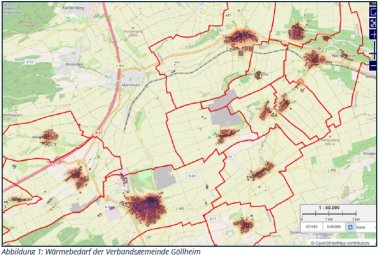
With the introduction of the revised Heat Planning Act (WPG) and the Building Energy Act (GEG), which both came into force on 1 January 2024, German municipalities and cities are facing the challenge of decarbonizing their heating systems by 2045. All German municipalities are obliged to draw up a municipal heating plan (kWP) by 2028 at the latest. The kWP serves as a strategic instrument that provides citizens, companies and energy suppliers with information about the future heat supply. To this end, a heating plan is drawn up, which comprises the strategic development based on a roadmap including measures to achieve climate neutrality in the heating sector.
The municipal heat planning for VG Göllheim was completed over a period of 12 months, from January 2025 to December 2025. The municipality, EWR Climate Connection GmbH and Hansa Luftbild Mobile Mapping GmbH were involved in the preparation.
Insights into municipal heat planning
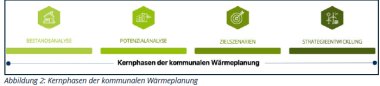
Municipal heat planning is a strategic process that describes the future heat planning within a municipality. As part of this process, a municipal heating plan is drawn up, which shows the path to climate neutrality in the heating sector in report form. This shows a guideline for action for the conversion from fossil to renewable heating systems. In addition, a strategic plan and measures to reduce CO2 emissions in the heating sector are derived. The focus is on heat supply sources that avoid CO2 emissions and at the same time offer a financially viable alternative to existing oil or gas heating systems.
The main aim of heat planning is to replace fossil fuels with environmentally friendly alternatives such as geothermal energy, solar thermal energy, biomass or waste heat recovery, while at the same time reducing overall energy consumption. In this way, local authorities not only create the basis for a sustainable heat supply, but also make a significant contribution to achieving climate targets and improving the quality of life locally.
Phases of municipal heat planning:
Inventory analysis
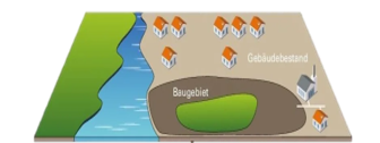
The existing supply structure is recorded and all buildings are mapped according to their types, their building structure and their heat consumption (for space heating, hot water and process heat). On this basis, the resulting greenhouse gas emissions are calculated in order to develop targeted measures to reduce emissions in the VG.
Data collection and recording: First of all, all relevant data on heat supply is collected, such as energy consumption, heating systems and infrastructure.
Data validation and supplementation: The recorded data is checked for accuracy and completeness and supplemented if necessary.
Preparation of a heat, energy and greenhouse gas balance according to BISKO: A comprehensive balance sheet is prepared to evaluate and analyze the municipality's energy consumption and CO2 emissions.
Cartographic representation in a GIS system: The data is digitally mapped in order to visualize the heat supply and infrastructure and enable targeted analysis.
Potential analysis
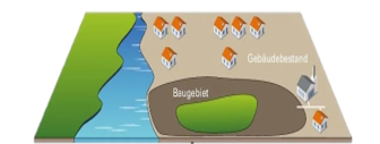
In the VG Göllheim, all potentials for environmentally friendly heat generation and for reducing heat demand are being jointly analyzed. This includes examining how existing heat sources and unavoidable waste heat can be used efficiently in order to make the heat supply in the VG sustainable. There is potential in the area of electricity generation through photovoltaics and wind energy as well as in the heating sector through innovative solutions such as local and district heating networks or the use of heat pumps.
Energy-saving potential: Opportunities to reduce heat consumption through more efficient heating systems, better insulation and optimized operational management are identified.
Potential of renewable energies and waste heat: Possibilities for the use of renewable energies (such as solar thermal energy or heat pumps) and waste heat sources (e.g. industrial waste heat) are analyzed.
These steps help to reduce energy consumption and integrate sustainable energies.
Target scenario development
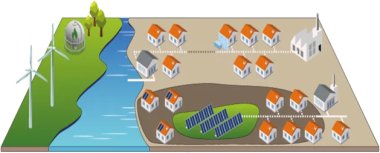
Following on from the analysis of the existing situation and potential, transformation targets are defined together with the steering group and the steering committee of the VG Göllheim. These targets take into account the future development of heat demand and the planned supply structure and are intended to ensure that heat demand is covered sustainably. In this way, an environmentally friendly, efficient heat supply can be created for the coming years.
Target image for the VG Göllheim
Transformation targets were defined based on the potential. These targets describe what the heat supply should look like in the VG in 2045. In the future heating landscape, a small number of buildings will be supplied centrally via a building network (approx. 5 %). The decentralized supply of the buildings in turn accounts for the majority of the heat supply. For the future scenario in 2045, the decentralized supply obtains heat from the following sources:
Air/ground source heat pumps: 59 %
Micro heat networks: 5 %
Green gases: 12 %
Direct electricity: 10 %
Solar thermal: 9 %
Biomass: 5 %
In addition, a refurbishment quota of 1.6 % was set to bring houses with a low energy efficiency class up to the level of energy efficiency classes A-D.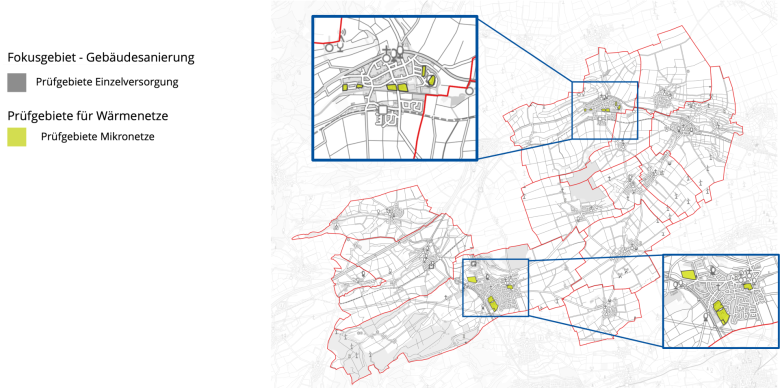
Catalog of measures
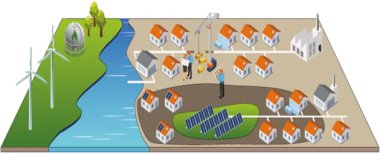
The final phase comprises the development of a strategic catalog of measures to achieve the goal of a climate-neutral heat supply. This is a long-term process of municipal heat planning in which all relevant local stakeholders are actively involved. The defined measures are continuously reviewed for their feasibility and effectiveness to ensure that we react flexibly to changes and find the best possible solutions for our local authority.
Measures
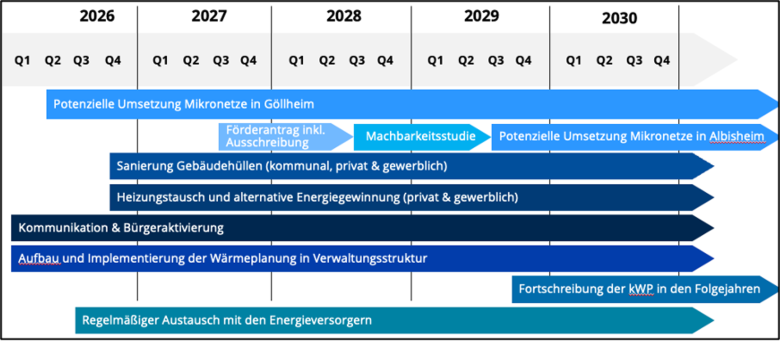
The following measures for implementing the heating plan have been identified and will be prioritized over the next five years, i.e. until the new heating plan is drawn up.
In the area of heating network measures, the construction of new micro-networks and the expansion of existing ones at suitable locations within the municipality are to be examined. The aim is to bundle and efficiently develop local heat requirements and integrate renewable heat sources as close to the building as possible. Tests are planned for the following network options:
Focus area 1: Göllheim school and sports center building network test area
Focus area 2: Göllheim Raiffeisenstraße-K80 building network test area
Focus area 3: Albisheim building network test area Untere Bahnhofstraße - Pfrimmhalle
In addition to these site-specific grid audits, community-wide steps are being considered to support the heating transition: the renovation of building envelopes to reduce heating requirements, the switch to alternative energy generation and the replacement of existing heating systems, as well as active citizen participation to strengthen acceptance and co-design.
Who finances municipal heat planning?
A project funded by the federal government
The measure, which cost just under €70,000, is 90% funded. With the National Climate Initiative, the German government has been initiating and funding numerous projects that contribute to reducing greenhouse gas emissions since 2008. Its programs and projects cover a broad spectrum of climate protection activities: From the development of long-term strategies to concrete assistance and investment-based funding measures. This diversity is a guarantee for good ideas. The National Climate Initiative helps to anchor climate protection on the ground. It benefits consumers as well as companies, local authorities and educational institutions.
Do you have questions about municipal heat planning?
- The following is a list of the most frequent questions asked by citizens in the context of municipal heat planning (kWP).
- The following is a list of the most frequently asked questions on the subject of data protection and data collection that arise in the context of municipal heat planning (kWP).